
Design Patterns
Understanding the advantages of using design patterns in development

What Are Design Patterns?
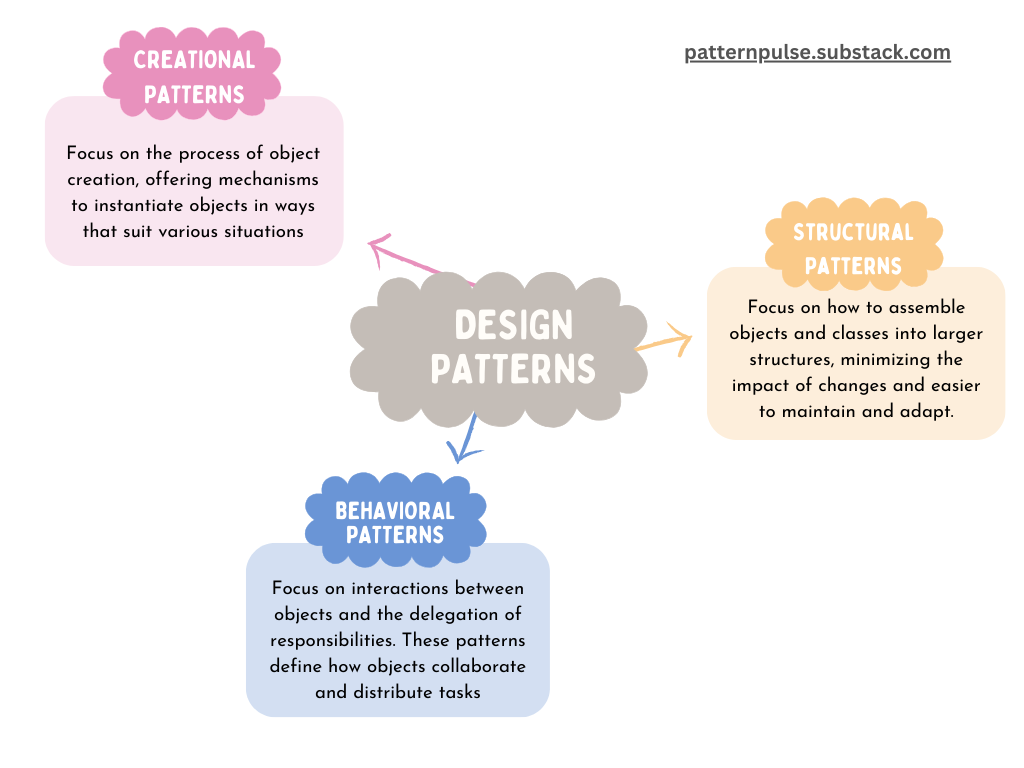
Design patterns are standardized solutions to common software design problems. They offer proven methods to address recurring issues and improve code structure. Patterns come in three main categories:
Creational Patterns
Structural Patterns
Behavioral Patterns
Creational Patterns
Focus on the process of object creation, offering mechanisms to instantiate objects in ways that suit various situations
Singleton: Ensures that a class has only one instance and provides a global point of access to that instance.
Factory Method: Defines an interface for creating objects but allows subclasses to alter the type of objects that will be created.
Abstract Factory: Creates families of related objects without specifying their concrete classes, providing a way to produce sets of related objects.
Builder: Constructs a complex object step-by-step, allowing for different representations of the object based on the configuration of the builder.
Prototype: Creates new objects by copying an existing object, which can be more efficient than creating new instances from scratch, especially for complex objects.
Structural Patterns
Focus on how to assemble objects and classes into larger structures, minimizing the impact of changes and easier to maintain and adapt.
Adapter: Allows objects with incompatible interfaces to work together by wrapping an existing class with a new interface.
Bridge: Separates an abstraction from its implementation, allowing both to evolve independently.
Composite: Composes objects into tree structures to represent part-whole hierarchies, allowing clients to treat individual objects and compositions uniformly.
Decorator: Adds new functionality to objects dynamically without altering their structure.
Facade: Provides a simplified interface to a complex subsystem, making it easier to use.
Flyweight: Reduces the cost of creating and manipulating a large number of similar objects by sharing common parts of the state.
Proxy: Provides a surrogate or placeholder for another object to control access to it.
Behavioral Patterns
Focus on interactions between objects and the delegation of responsibilities. These patterns define how objects collaborate and distribute tasks.
Chain of Responsibility: Passes a request along a chain of handlers, allowing multiple objects the chance to handle the request.
Command: Encapsulates a request as an object, thereby allowing for parameterization and queuing of requests.
Interpreter: Provides a way to evaluate language grammar or expression, often used in designing languages or interpreters.
Iterator: Provides a way to access the elements of an aggregate object sequentially without exposing its underlying representation.
Mediator: Defines an object that encapsulates how a set of objects interact, promoting loose coupling.
Memento: Captures and externalizes an object's internal state without violating encapsulation, allowing the object to be restored to that state later.
Observer: Defines a dependency between objects so that when one object changes state, all its dependents are notified and updated automatically.
State: Allows an object to alter its behavior when its internal state changes, appearing to change its class.
Strategy: Defines a family of algorithms, encapsulates each one, and makes them interchangeable, allowing the algorithm to vary independently from clients that use it.
Template Method: Defines the skeleton of an algorithm in a base class but lets subclasses override specific steps of the algorithm without changing its structure.
Visitor: Allows operations to be performed on elements of an object structure without changing the classes of the elements.
The Importance of Design Patterns:
Reusability and Efficiency: Patterns provide reusable solutions, saving time and avoiding redundancy.
Maintainability and Scalability: They help in creating code that is easier to maintain and scale applications.
Flexibility and Adaptability: They make it easier to adapt and extend application as requirements change.